Cenotaph Requiem
Dedicated to all who served King and country
Marking the centenary of The Armistice of November 1918, The Coldstream Guards Band present the first performance of Cenotaph - a poignant musical reflection of the service, co-operation and sacrifice of soldiers, sailors and airmen during the First World War 1914-1918.
Cenotaph
Composed by Major Simon Haw MBE
Introit
Requiem æternam dona eis, Domine:
et lux perpetua luceat eis.
Te decet hymnus, Deus, in Sion,
et tibi reddetur votum in Jerusalem:
exaudi orationem meam,
ad te omnis caro veniet.
Requiem æternam dona eis, Domine:
et lux perpetua luceat eis.
Kyrie eleison
Kyrie, eleison.
Christe, eleison.
Kyrie, eleison.
Marne - instrumental portrait
Sanctus
Sanctus, Sanctus, Sanctus
Dominus Deus Sabaoth.
Pleni sunt cæli et terra gloria tua.
Hosanna in excelsis.
Benedictus qui venit in nomine Domini.
Hosanna in excelsis.
Gallipoli - instrumental portrait
Jutland - instrumental portrait
Agnus Dei
Agnus Dei, qui tollis peccata mundi: dona eis requiem.
Agnus Dei, qui tollis peccata mundi: dona eis requiem.
Agnus Dei, qui tollis peccata mundi: dona eis
requiem sempiternam.
Somme - instrumental portrait
Pie Jesu - Soloists: Danni O’Neill and Kirsty O’Neill
Pie Jesu Domine, dona eis requiem.
Dona eis requiem sempiternam.
Passchendaele - instrumental portrait
In Paradisum
In paradisum deducant te Angeli:
in tuo adventu suscipiant te Martyres,
et perducant te in civitatem sanctam Jerusalem.
Chorus Angelorum te suscipiat,
et cum Lazaro quondam paupere æternam habeas requiem.
Last Post - LCpl Nick Mott
Eternal rest give unto them, O Lord,
and let perpetual light shine upon them.
A hymn, O God, becometh Thee in Sion;
and a vow shall be paid to Thee in Jerusalem:
hear my prayer;
all flesh shall come to Thee.
Eternal rest give unto them, O Lord,
and let perpetual light shine upon them.
Lord, have mercy.
Christ, have mercy.
Lord, have mercy.
Holy, holy, holy,
Lord God of Hosts.
Heaven and earth are full of Thy glory.
Hosanna in the highest.
Blessed is He Who cometh in the Name of the Lord.
Hosanna in the highest.
Lamb of God, Who takest away the sins of the world, grant them rest.
Lamb of God, Who takest away the sins of the world, grant them rest.
Lamb of God, Who takest away the sins of the world, grant them eternal rest.
Merciful Lord Jesus, grant them rest;
grant them eternal rest.
May the Angels lead thee into paradise:
may the Martyrs receive thee at thy coming,
and lead thee into the holy city of Jerusalem.
May the choir of Angels receive thee,
and mayest thou have eternal rest with Lazarus, who once was poor.
Battle of the Marne
By the September of 1914 the German offensive through Europe seemed unstoppable. From the day Germany declared war on France on 3 August, the fight had been one-sided. German forces advanced like lightning through neutral Belgium and the French countryside. By 2 September German cavalrymen had crossed the Marne River and were spotted on the outskirts of Meaux, only 25 miles northeast of the French capital. Throughout the night of 1 September sporadic air raids heightened the sense of panic within the French capital city. This was further escalated as German biplanes continued to drop propaganda from the skies, claiming: “There is nothing you can do but surrender.” As many inhabitants urged for Paris to be made an open city, others crowded on to train platforms in an attempt to flee the German invasion.
It seemed a miracle was needed to save Paris and, on 3 September, it appeared in the form of an overzealous German Commander. General Alexander von Kluck, decided to disobey his orders to support the Second Army in order to guard against possible attacks from Paris. Instead the aggressive von Kluck sought glory and a chance to drive a stake in the enemy by pursuing the retreating French Fifth Army across the Marne River just east of Paris. By doing so his troops, exhausted after weeks of marching and fighting, outran their supply lines. This inadvertently exposed his right flank to French forces.
The allied forces seized upon this opportunity and the battle raged for three days along a 100 mile front. This was the first major battle of the First World War which saw the use of machine guns and modern artillery. Over 100,000 would meet their end in this crucial battle that put a stop to the German advance. Over the following months both sides attempted to outflank each other and slowly but surely Europe was severed in two as the armies settled into the slow relentless grind of trench warfare. This would continue until the end of the war in 1918.
On 20 August 1914 Edith Cavell, a British nurse working in a nursing school in Brussels, soon found herself behind enemy lines as the city became occupied. Her training school became a Red Cross hospital, treating both German and allied wounded soldiers. Edith began smuggling allied soldiers out of occupied Belgium and into the Netherlands. Over the next 11 months she helped approximately 200 British, French and Belgian soldiers, sheltering them in the hospital and arranging for guides to take them to the border. On 5 August 1915, she was arrested for this activity and placed in solitary confinement. Subsequently she was tried by court martial, found guilty and sentenced to death. Edith was executed by firing squad on 12 October 1915.
The death of a woman under such circumstances caused a wave of revulsion throughout the civilised world. Besides a memorial service in St Paul’s, Edith was the first female commoner to be given a state funeral at Westminster Abbey. She became a symbol of the allied cause, her memory being invoked in recruitment posters and messages across Britain and around the world.
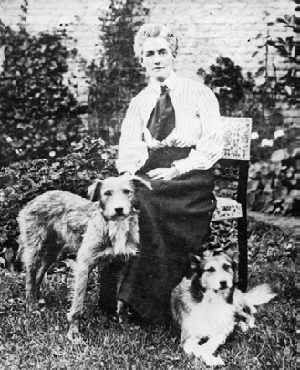
Edith Cavell
In one of her final letters, written in October 1915 and addressed to a fellow nurse, Edith wrote:
“I am asking you to take charge of my will and do a few things for me – you have been very kind my dear and I thank you and the nurses for all you have done for me in these last 10 weeks. My love to you all – I am not afraid but quite happy. Yours, E. Cavell”
Battle of Gallipoli
In early 1915 the First World War had already been raging for seven months with the British Expeditionary Forces (BEF) suffering heavy losses on the Western Front. On the Eastern Front the Russian Army had fared no better in the Battles of Tannenberg and the Masurian Lakes. The German Army, despite enduring equally heavy losses at Mons and Marne, seemed almost unstoppable. To add to Russian woes, Kaiser Wilhelm’s forces had extended their influence in the Ottoman Empire, forcing the closure of the Dardanelles. This narrow strait, situated in modern-day Turkey, linked the Mediterranean to the Black Sea. This was perceived as a key Russian economic lifeline and the Tsar’s government pleaded with Britain and France for their assistance in reclaiming this vital piece of territory.
The British and French governments duly responded and the task of recapturing the Dardanelles fell to General Sir Ian Hamilton. Almost half of his army consisted of soldiers enlisted from the dominions (self – governing British Commonwealth nations).
At the outbreak of war in 1914 the call to arms had sounded in every corner of the Empire and the response displayed an extraordinary sense of solidarity. New Zealand historian Christopher Pugsley wrote: “In New Zealand the university classes emptied… sports fixtures were abandoned. To be left behind was unthinkable. If your mate was going, then somehow you had to get away too”. In Canada, Australia the reaction was simliar and even Boer leaders in South Africa rallied to the British war cry.
In 1914 the Indian Army was only slightly smaller than the British Army and represented a vital element of the Empire’s military resources. It is hard to imagine how terrifying the upheaval must have been for the average Indian soldier of that time. As Gordon Corrigan, a military historian, writes:
“[they were] thrust into a country of which they knew nothing, subjected to a climate never before experienced, fighting an enemy the like of which they had never imagined...”
The campaign in Gallipoli saw some of the fiercest fighting of the war. Nine Australians and one New Zealander received the Victoria Cross for their actions, and this chapter in the war would be remembered by its veterans as one of the worst places to serve. The ferocity of the fighting, combined with intense heat, swarms of flies, body lice, severe lack of water and rations would eventually result in hundreds of thousands of casualties.
Whilst contemporary reports of the campaign remained intentionally vague (in order to avoid lowering morale back home) the reality of this brutal episode in the war was documented in hundreds of letters written by ordinary soldiers.
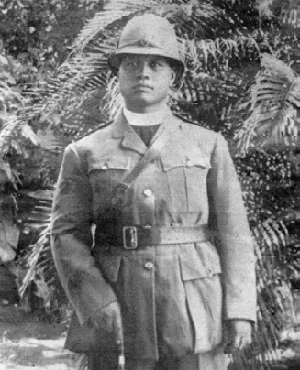
Captain Henare Wainohu
Letter from Captain Henare Wainohu to Poihipi Kohere, October, 1916:
Dear Poi,
Greetings to you and your family...Neither paper nor pen can express the bitter sorrow for the young Maoris who have made the supreme sacrifice for King, the nation and the whole world. Members of leading families of the Maori people, both the North and South Islands, now lie on the fields of France. We as Maoris feel it very much, and our thoughts constantly wonder homewards to the parents and the people...The letters we receive from home are brave and comforting when they say that to die on the battlefield is to die an honourable death. The boys who have made the supreme sacrifice all died like soldiers...
Your old friend,
Henare Te Wainohu.
Battle of Jutland
One largely associates the First World War with land locked trench warfare and, for the majority, this was indeed the case. However, one of the most crucial moments occurred at sea. The Battle of Jutland was the largest naval battle of the First World War and it was the only time that the British and German fleets of ‘dreadnought’ battleships actually came to blows.
Taking place in the North Sea on 31 May and 1 June the battle involved over 250 ships and 100 000 men. Although, that said, it is thought that almost a third of these ‘men’ were in fact under the legal age of combat. Not wishing to be left at home whilst their elder brothers and fathers fought for their freedom, these brave boys volunteered to fight for King and country.
One such boy soldier was Jack Cornwell. Aged only 15, he lied about his age in order to join the war effort. A year later he found himself stationed on-board HMS Chester, part of the British naval fleet which would see action at Jutland. This battleship found itself in the very thick of the fight and, as the Chester’s Commanding Officer later wrote:
“Boy (1st Class) John Travers Cornwell of the “Chester” was mortally wounded early in the action. He nevertheless remained standing alone at a most exposed post, quietly awaiting orders ‘till the end of the action, with the gun’s crew dead and wounded all round him.”
On 29 July 1916, paying homage to this young boy’s incredible bravery, his body was carried by gun carriage from East Ham town hall to Manor Park cemetery where he was buried with full naval honours.
On 15 September 1916 an official citation appeared in the London Gazette stating that John Travers Cornwell had posthumously been awarded the Victoria Cross by King George V.
On 16 November 1916 Jack’s mother made the long journey from her East London poor house to Buckingham Palace, where King George V presented her young son’s posthumous award.
During the Battle of Jutland, Britain lost 14 ships and over 6,000 men whilst the Germans lost 11 ships and over 2,500 men. Although it failed to achieve the decisive victory each side hoped for, this battle confirmed British naval dominance and secured its control of shipping lanes. This allowed Britain to implement the blockade that would contribute to Germany’s eventual defeat in 1918.
It is estimated that almost 250 000 young boys, just like Jack Cornwell, volunteered to fight for their country in the First World War. Of these it is thought that over half were either wounded, killed or taken prisoner.
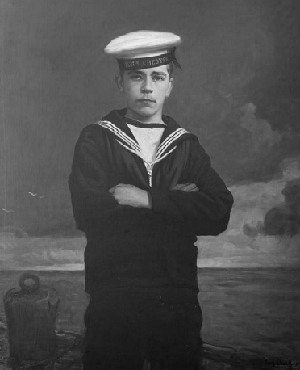
John (Jack) Cornwell
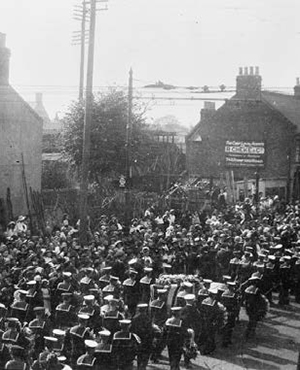
The funeral procession for Jack Cornwell VC. Jack was buried with full naval honours on 29 July 1916.
Battle of the Somme
“Although the war had been over for more than ten years, I was still troubled by frequent nightmares; they all took the same form. I was still there in the trenches with a few men; we knew the armistice had been signed, but we had been forgotten; so had a section of the Germans opposite. It was as though we were both doomed to fight on till extinction. I used to wake with horror”. Arthur Bliss (1891 – 1975).
The price of war is often measured in figures: thousands dead, millions injured.
These numbers allow us to try and comprehend the enormity of what has happened but the true cost of war often goes beyond such statistics. When war broke out in 1914 hundreds of thousands of young men hurried to join the army, not only in Britain but also in France and Germany. However, in amongst these brave souls, a number of the world’s finest musicians and composers would find themselves placed on the front lines of this terrible conflict. Whilst many would survive, albeit forever altered by the brutality of war, an untold number of artists would pay the ultimate sacrifice, resulting in a lost generation of musicians.
The Battle of the Somme, often cited as one of the bloodiest and most bitterly fought of the entire war, began on 1 July 1916. After a week-long bombardment of the German lines, British forces began their advance. However, alarmingly they found the German defences had survived the intensive shelling largely intact. As a result the advance ground to a complete halt and the Battle of the Somme would become one of attrition. Despite lasting nearly five months it is this first day of the battle that is historically remembered most. On this day alone of there were 57,470 casualties. Of these 19,240 were killed and, whilst this would represent the highest loss of life in a single day for British forces, the casualty rate would remain high throughout this deadly stalemate.
A number of distinguished British musicians fought at the Somme. Gordon Jacob served alongside his brother and would eventually be taken as a prisoner of war whilst his brother would be forever lost to the mud and slime of no-man’s land. In 1928 he would write the Lento e mesto in his First Symphony in memory of his sibling. One group of emerging composers studying at the Royal College of Music enlisted in time for the Somme. This comprised of Ivor Gurney, Arthur Bliss, Arthur Benjamin, and Francis Purcell Warren and every one of these men would be affected dramatically by their experiences with Gurney and Bliss both losing brothers and Benjamin witnessing the decimation of his entire unit. They would never truly escape these memories and Gurney, later survived Passchendaele in 1917. He would later be committed to a mental institute where he would see out his days until his death in 1937. Francis Purcell Warren, a star violist and promising composer, served as a 2nd Lieutenant in the 10th Battalion of the South Lancashire Regiment. Reported missing on 3 July, he was probably killed the previous day south of Thiepval. His body, unrecovered, has no grave.
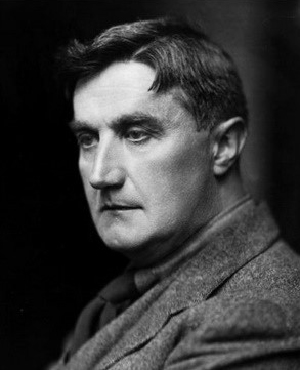
Ralph Vaughan Williams
Arguably the most prominent of all the British composers to have fought at the Somme is Ralph Vaughan Williams who served as a medical orderly, a harrowing task which, amongst other grisly duties, saw him picking up body parts in no-man’s land. Vaughan Williams would lose many friends to the war, most notably fellow composer George Butterworth whom he regarded as a greater talent than himself. Reflecting on his experiences since 1914 Vaughan Williams wrote to Gustav Holst, whom he corresponded with regularly, in 1916:
“I sometimes dread coming back to normal life with so many gaps...out of those 7 who joined up together in August 1914 only 3 are left - I sometimes think now that it is wrong to have made friends with people younger than oneself ”.
Passchendaele
Officially known as the Third Battle of Ypres, Passchendaele became infamous not only for the scale of casualties, but also for the mud. Ypres was the principal town within a salient (or bulge) in the British lines and the site of two previous battles: First Ypres (October-November 1914) and Second Ypres (April-May 1915). Haig had long wanted a British offensive in Flanders and, following a warning that the German blockade would soon cripple the British war effort, wanted to reach the Belgian coast to destroy the German submarine bases there. On top of this, the possibility of a Russian withdrawal from the war threatened German redeployment from the Eastern front to increase their reserve strength dramatically.
The British were further encouraged by the success of the attack on Messines Ridge on 7 June 1917. Nineteen huge mines were exploded simultaneously after they had been placed at the end of long tunnels under the German front lines. The capture of the ridge inflated Haig’s confidence and preparations began. Yet the flatness of the plain made stealth impossible: as with the Somme, the Germans knew an attack was imminent and the initial bombardment served as final warning. It lasted two weeks, with 4.5 million shells fired from 3,000 guns, but again failed to destroy the heavily fortified German positions.
The infantry attack began on 31 July. Constant shelling had churned the clay soil and smashed the drainage systems. The left wing of the attack achieved its objectives but the right wing failed completely. Within a few days, the heaviest rain for 30 years had turned the soil into a quagmire, producing thick mud that clogged up the rifles and immobilised tanks. It eventually became so deep that men and horses drowned in it.
On 16 August the attack was resumed, to little effect. Stalemate reigned for another month until an improvement in the weather prompted another attack on 20 September. The Battle of Menin Road Ridge, along with the Battle of Polygon Wood on 26 September and the Battle of Broodseinde on 4 October, established British possession of the ridge east of Ypres.
Further attacks in October failed to make much progress. The eventual capture of what little remained of Passchendaele village by British and Canadian forces on 6 November finally gave Haig an excuse to call off the offensive and claim success.
However, Passchendaele village lay barely five miles beyond the starting point of his offensive. Having prophesied a decisive success, it had taken over three months, 325,000 Allied and 260,000 German casualties to do little more than make the bump of the Ypres salient somewhat larger. In Haig’s defence, the rationale for an offensive was clear and many agreed that the Germans could afford the casualties less than the Allies, who were being reinforced by America’s entry into the war. Yet Haig’s decision to continue into November remains deeply controversial and the arguments, like the battle, seem destined to go on and on.
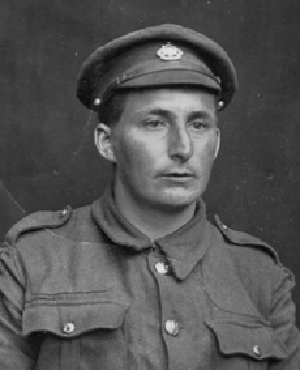
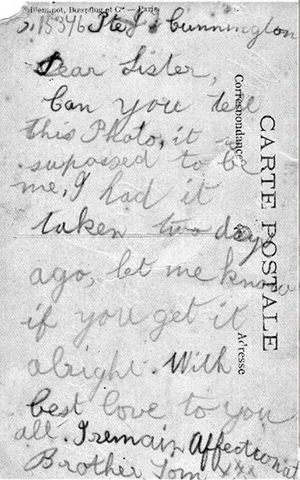
Private Tom Cunnington, Lincolnshire Regiment, from Easton near Grantham. Missing presumed dead on 31st July 1917. He wrote the postcard to his sister Ethel not long before he was killed. His body remains there and has never been found. May he rest in peace.
